Nonfiction 2025
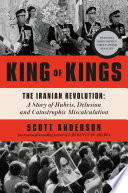
The Iranian RevolutionâA Story of Hubris, Delusion and Catastrophic Miscalculation
2025
Finalist for the 2025 National Book Critics Circle Award for Nonfiction • A New York Times Notable Book of the Year • Named a Best Book of 2025 by Wall Street Journal, The Atlantic, and Globe and Mail From the author of the acclaimed international bestseller Lawrence in Arabia, a stunningly revelatory narrative history of one of the most momentous events in modern times and the dawn of the age of religious nationalism. On November 16th, 1977, at a state dinner in the White House, President Jimmy Carter toasted Shah Mohammad Reza Pahlavi, King of Kings, Light of the Aryans, Shadow of God on Earth, praising his “enlightened leadership” and extolling Iran as “a stabilizing influence in that part of the world.” Iran had the world’s fifth largest army and was awash in billions of dollars in oil revenues.
Read more
Finalist for the 2025 National Book Critics Circle Award for Nonfiction • A New York Times Notable Book of the Year • Named a Best Book of 2025 by Wall Street Journal, The Atlantic, and Globe and Mail From the author of the acclaimed international bestseller Lawrence in Arabia, a stunningly revelatory narrative history of one of the most momentous events in modern times and the dawn of the age of religious nationalism. On November 16th, 1977, at a state dinner in the White House, President Jimmy Carter toasted Shah Mohammad Reza Pahlavi, King of Kings, Light of the Aryans, Shadow of God on Earth, praising his “enlightened leadership” and extolling Iran as “a stabilizing influence in that part of the world.” Iran had the world’s fifth largest army and was awash in billions of dollars in oil revenues. Construction cranes dotted the skyline of its booming capital, Tehran. The regime’s feared secret police force SAVAK had crushed communist opposition, and the Shah had bought off the conservative Muslim clergy inside the country. He seemed invulnerable, and invaluable to the United States as an ally in the Cold War. Fourteen months later the Shah fled Iran into exile, forced from the throne by a volcanic religious revolution led by a fiery cleric named Ayatollah Khomeini. How could the United States (and other Western allies), which had one of the largest CIA stations in the world and thousands of military personnel in Iran, have been so blind? The spellbinding story Scott Anderson weaves is one of a dictator oblivious to the disdain of his subjects and a superpower blundering into disaster. The Shah emerges as a fascinating, Shakespearean character – a wannabe Richard III unaware of the depth of dissent to his rule, indecisive like Hamlet when action was called for, and at the end Lear-like as he raged against his fate. The Americans made terrible decisions at almost every juncture, from a secret pact designed by Kissinger and Nixon, to dismissing reports from the one diplomat who saw how hated the Shah was by the Iranian people (unlike almost all his colleagues, he spoke Farsi), to Jimmy Carter allowing the Shah to come to America for medical treatment, which set off the hostage crisis which forever damaged American influence in the world. Scott Anderson tells this astonishing tale with the narrative brio, mordant wit, and keen analysis that made his bestselling Lawrence in Arabia one of the key texts in understanding the modern Middle East. Based on voluminous research and dozens of interviews, King of Kings is driven by penetrating portraits of the people involved – the Iranian-American doctor who convinced American officials Khomeini was a moderate; the American teacher who learned of Khomeini’s influence long before the cleric was even mentioned in official reports; the Shah’s court minister who kept a detailed diary of all their interactions; the Shah’s wife Farah who still mourns her lost kingdom; the hypocritical and misguided Jimmy Carter; and the implacable Khomeini who outmaneuvered his foes at every turn. The Iranian Revolution, Anderson convincingly argues, was as world-shattering an event as the French and Russian revolutions. In the Middle East, in India, in Southeast Asia, in Europe, and the United States, the hatred of economically-marginalized, religiously-fervent masses for a wealthy secular elite has led to violence and upheaval – and Iran was the template. King of Kings is a bravura work of history, and a warning.
A Love Story
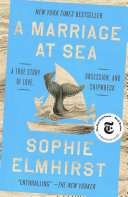
A True Story of Love, Obsession, and Shipwreck
2025
THE RUNAWAY NEW YORK TIMES BESTSELLER & ONE OF BARACK OBAMA’S FAVORITE BOOKS OF 2025 A NEW YORK TIMES TOP 10 BOOK OF 2025 ALSO NAMED A BEST BOOK OF 2025 BY NPR, VOGUE, TIME MAGAZINE, THE NEW YORKER, AND MORE “This is nonfiction that reads like fiction – the best kind. Elmhirst’s retelling is a triumph, second only to the seemingly impossible feat of Maurice and Maralyn themselves.
Read more
THE RUNAWAY NEW YORK TIMES BESTSELLER & ONE OF BARACK OBAMA’S FAVORITE BOOKS OF 2025 A NEW YORK TIMES TOP 10 BOOK OF 2025 ALSO NAMED A BEST BOOK OF 2025 BY NPR, VOGUE, TIME MAGAZINE, THE NEW YORKER, AND MORE “This is nonfiction that reads like fiction – the best kind. Elmhirst’s retelling is a triumph, second only to the seemingly impossible feat of Maurice and Maralyn themselves. You won’t be able to put it down.” – USA Today “Remarkable… I found myself, alternately, holding my breath as I read at top speed, wandering rooms in search of someone to read aloud to, and placing the book facedown, arrested by quiet statements that left me reeling with their depth.” – The New York Times “Such an emotionally vivid portrait of a couple in isolation that I was shocked it wasn’t fiction. How could a writer get so deeply into the minds of two real people in such extraordinary circumstances? … So brilliantly depicted.” – Elle “A beautiful meditation on endurance, codependence, and the power of love. A dazzling book.” – Patrick Radden Keefe “An enthralling, engrossing story of survival and the resilience of the human spirit.” —Bill Bryson An instant New York Times bestseller, this is the electrifying true story of a young couple shipwrecked at sea: a mind-blowing tale of obsession, survival, and partnership stretched to its limits. Maurice and Maralyn make an odd couple. He’s a loner, awkward and obsessive; she’s charismatic and ambitious. But they share a horror of wasting their lives. And they dream – as we all dream – of running away from it all. What if they quit their jobs, sold their house, bought a boat, and sailed away? Most of us begin and end with the daydream. But in June 1972, Maurice and Maralyn set sail. For nearly a year all went well, until deep in the Pacific, a breaching whale knocked a hole in their boat and it sank beneath the waves. What ensues is a jaw-dropping fight to survive in the wild ocean, with little hope of rescue. Alone together for months in a tiny rubber raft, starving and exhausted, Maurice and Maralyn have to find not only ways to stay alive but ways to get along, as their inner demons emerge and their marriage is put to the greatest of tests. Although they could run away from the world, they can’t run away from themselves. Taut, propulsive, and dazzling, A Marriage at Sea pairs an adrenaline-fueled high seas adventure with a gutting love story that asks why we love difficult people, and who we become under the most extreme conditions imaginable.
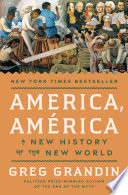
A New History of the New World
2025
A New York Times bestseller • A finalist for the National Book Critics Circle Award, 2025 Kirkus Prize, 2025 Cundill History Prize, and 2026 Andrew Carnegie Medal for Excellence in Nonfiction • Named a Best Book of the Year by The New Yorker,The New Republic, and Mother Jones “An extraordinarily ambitious book . .
Read more
A New York Times bestseller • A finalist for the National Book Critics Circle Award, 2025 Kirkus Prize, 2025 Cundill History Prize, and 2026 Andrew Carnegie Medal for Excellence in Nonfiction • Named a Best Book of the Year by The New Yorker,The New Republic, and Mother Jones “An extraordinarily ambitious book . . . America, América reads at times as the historical equivalent of the great epic novels of Gabriel García Márquez.” —Irish Times From the Pulitzer Prize–winning historian, the first comprehensive history of the Western Hemisphere, a sweeping five-century narrative of North and South America that redefines our understanding of both The story of how the United States’ identity was formed is almost invariably told by looking east to Europe. But as Greg Grandin vividly demonstrates, the nation’s unique sense of itself was in fact forged facing south toward Latin America. In turn, Latin America developed its own identity in struggle with the looming colossus to the north. In this stunningly original reinterpretation of the New World, Grandin reveals how North and South emerged from a constant, turbulent engagement with each other. America, América traverses half a millennium, from the Spanish Conquest—the greatest mortality event in human history—through the eighteenth-century wars for independence, the Monroe Doctrine, the coups and revolutions of the twentieth century, and beyond. Grandin shows, among other things, how in response to U.S. interventions, Latin Americans remade the rules, leading directly to the founding of the United Nations; and how the Good Neighbor Policy allowed FDR to assume the moral authority to lead the fight against world fascism. Grandin’s book sheds new light on well-known historical figures like Bartolomé de las Casas, Simón Bolívar, and Woodrow Wilson, as well as lesser-known actors such as the Venezuelan Francisco de Miranda, who almost lost his head in the French Revolution and conspired with Alexander Hamilton to free America from Spain; the Colombian Jorge Gaitán, whose unsolved murder inaugurated the rise of Cold War political terror, death squads, and disappearances; and the radical journalist Ernest Gruening, who, in championing non-interventionism in Latin America, helped broker the most spectacularly successful policy reversal in United States history. This is a monumental work of scholarship that will fundamentally change the way we think of Spanish and English colonialism, slavery and racism, and the rise of universal humanism. At once comprehensive and accessible, America, América shows that centuries of bloodshed and diplomacy not only helped shape the political identities of the United States and Latin America but also the laws, institutions, and ideals that govern the modern world. In so doing, Grandin argues that Latin America’s deeply held culture of social democracy can be an effective counterweight to today’s spreading rightwing authoritarianism. A culmination of a decades-long engagement with hemispheric history, drawing on a vast array of sources, and told with authority and flair, this is a genuinely new history of the New World.
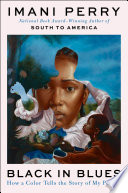
How a Color Tells the Story of My People
2025
A “vast, multifaceted and enchanting” (Minneapolis Star-Tribune) meditation on the color blue and its fascinating role in Black history and culture, from National Book Award winner Imani Perry, “the most important interpreter of Black life in our time” (Eddie S. Glaude, Jr.) Throughout history, the concept of Blackness has been remarkably intertwined with another color: blue.
Read more
A “vast, multifaceted and enchanting” (Minneapolis Star-Tribune) meditation on the color blue and its fascinating role in Black history and culture, from National Book Award winner Imani Perry, “the most important interpreter of Black life in our time” (Eddie S. Glaude, Jr.) Throughout history, the concept of Blackness has been remarkably intertwined with another color: blue. In daily life, it is evoked in countless ways. Blue skies and blue water offer hope for that which lies beyond the current conditions. But blue is also the color of deep melancholy and heartache, echoing Louis Armstrong’s question, “What did I do to be so Black and blue?” In this book, celebrated author Imani Perry uses the world’s favorite color as a springboard for a riveting emotional, cultural, and spiritual journey—an examination of race and Blackness that transcends politics or ideology. Perry traces both blue and Blackness from their earliest roots to their many embodiments of contemporary culture, drawing deeply from her own life as well as art and history: The dyed indigo cloths of West Africa that were traded for human life in the 16th century. The mixture of awe and aversion in the old-fashioned characterization of dark-skinned people as “Blue Black.” The fundamentally American art form of blues music, sitting at the crossroads of pain and pleasure. The blue flowers Perry plants to honor a loved one gone too soon. Poignant, spellbinding, and utterly original, Black in Blues is a brilliant new work that could only have come from the mind of one of our greatest writers and thinkers. Attuned to the harrowing and the sublime aspects of the human experience, it is every bit as vivid, rich, and striking as blue itself.
2025
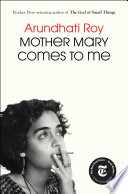
Named One of the New York Times Book Review's Top Ten Books of 2025 Finalist for the Kirkus Prize A raw and deeply moving memoir from the legendary author of The God of Small Things and The Ministry of Utmost Happiness that traces her complex relationship with her mother, Mary Roy, a fierce and formidable force who shaped Arundhati’s life both as a woman and a writer. Mother Mary Comes to Me, Arundhati Roy’s first work of memoir, is a soaring account, both intimate and inspirational, of how the author became the person and the writer she is, shaped by circumstance, but above all by her complex relationship to the extraordinary, singular mother she describes as “my shelter and my storm.” “Heart-smashed” by her mother Mary’s death in September 2022 yet puzzled and “more than a little ashamed” by the intensity of her response, Roy began to write, to make sense of her feelings about the mother she ran from at age eighteen, “not because I didn’t love her, but in order to be able to continue to love her.” And so begins this astonishing, sometimes disturbing, and surprisingly funny memoir of the author’s journey from her childhood in Kerala, India, where her single mother founded a school, to the writing of her prizewinning novels and essays, through today.
Read more
Named One of the New York Times Book Review's Top Ten Books of 2025 Finalist for the Kirkus Prize A raw and deeply moving memoir from the legendary author of The God of Small Things and The Ministry of Utmost Happiness that traces her complex relationship with her mother, Mary Roy, a fierce and formidable force who shaped Arundhati’s life both as a woman and a writer. Mother Mary Comes to Me, Arundhati Roy’s first work of memoir, is a soaring account, both intimate and inspirational, of how the author became the person and the writer she is, shaped by circumstance, but above all by her complex relationship to the extraordinary, singular mother she describes as “my shelter and my storm.” “Heart-smashed” by her mother Mary’s death in September 2022 yet puzzled and “more than a little ashamed” by the intensity of her response, Roy began to write, to make sense of her feelings about the mother she ran from at age eighteen, “not because I didn’t love her, but in order to be able to continue to love her.” And so begins this astonishing, sometimes disturbing, and surprisingly funny memoir of the author’s journey from her childhood in Kerala, India, where her single mother founded a school, to the writing of her prizewinning novels and essays, through today. With the scale, sweep, and depth of her novels, The God of Small Things and The Ministry of Utmost Happiness, and the passion, political clarity, and warmth of her essays, Mother Mary Comes to Me is an ode to freedom, a tribute to thorny love and savage grace—a memoir like no other.