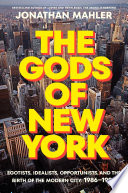
| Description | A sweeping chronicle of four tumultuous years in 1980s New York that changed the city forever—and anticipated the forces that would soon divide the nation—from the bestselling author of Ladies and Gentlemen, the Bronx Is Burning “A rip-roaring, sweeping, essential work of history . . . a deeply reported and brilliantly observed account of how the modern city was born and why all of us continue to live with the results.”—Jonathan Eig, Pulitzer Prize–winning author of King: A Life New York entered 1986 as a city reborn. Record profits on Wall Street sent waves of money splashing across Manhattan, bringing a battered city roaring back to life. But it also entered 1986 as a city whose foundation was beginning to crack. Thousands of New Yorkers were sleeping in the streets, addicted to drugs, dying of AIDS, or suffering from mental illnesses. Nearly one-third of the city’s Black and Hispanic residents were living below the federal poverty line. Long-simmering racial tensions threatened to boil over. The events of the next four years would split the city open. Howard Beach. Black Monday. Tawana Brawley. The crack epidemic. The birth of ACT UP. The Central Park jogger. The release of Do the Right Thing. And a cast of outsized characters—Ed Koch, Donald Trump, Al Sharpton, Spike Lee, Rudy Giuliani, Larry Kramer—would compete to shape the city’s future while building their own mythologies. The Gods of New York is a kaleidoscopic and deeply immersive portrait of a city whose identity was suddenly up for grabs: Could it be both the great working-class city that lifted up immigrants from around the world and the money-soaked capital of global finance? Could it retain a civic culture—a common idea of what it meant to be a New Yorker—when the rich were building a city of their own and vast swaths of its citizens were losing faith in the systems meant to protect them? New York City was one thing at the dawn of 1986; it would be something very different as 1989 came to a close. This is the story of how that happened.
===
New York City entered 1986 as a city reborn, with record profits on Wall Street sending waves of money splashing across Manhattan and bringing a once-bankrupt and reeling city back to life. But it also entered 1986 as a city divided. Nearly one-third of the city's Black and Hispanic residents were living below the poverty line. Thousands of New Yorkers were sleeping in the streets - and in many cases addicted to drugs, dying of AIDS, or suffering from mental illness. The manufacturing jobs that had once sustained a thriving middle class had vanished. Long-simmering racial tensions were boiling over. Over the next four years, a singular confluence of events - involving a cast of outsized, unforgettable characters - would widen those divisions into chasms. Ed Koch. Donald Trump. Al Sharpton. The Central Park Five. Larry Kramer. Spike Lee. Rudy Giuliani. Howard Beach. Tawana Brawley. The Preppy Murder. The Tompkins Square Riots. Jimmy Breslin. Ivan Boesky. Do the Right Thing, Wall Street, crack, the AIDS epidemic, Black Monday and, of course, ready to pour gasoline on every fire - the tabloids. In The Gods of New York, bestselling author Jonathan Mahler tells the story of these outsized characters and of these convulsive, defining years. It's an exuberant, kaleidoscopic, and deeply immersive portrait of a city in transformation, one whose long-held identity was suddenly up for grabs: Could it be both the great working-class city, drawing in and lifting up immigrants from around the world and the money-soaked capital of global finance? Could it retain a civic culture -- a common idea of what it meant to be a New Yorker -- when the rich were building a city of their own and vast swaths of its citizens were losing faith in the systems that were intended to protect them? New York was one thing at the dawn of 1986; it would be something very different as 1989 came to a close. This book is the story of how that happened.
===
NEW YORK TIMES BOOK REVIEW EDITORS’ CHOICE • A sweeping chronicle of four tumultuous years in 1980s New York that changed the city forever—and anticipated the forces that would soon divide the nation—from the bestselling author of Ladies and Gentlemen, the Bronx Is Burning “A rip-roaring, sweeping, essential work of history . . . a deeply reported and brilliantly observed account of how the modern city was born and why all of us continue to live with the results.”—Jonathan Eig, Pulitzer Prize–winning author of King: A Life A BEST BOOK OF THE YEAR: The New York Times Book Review, The Economist, The New Yorker, Town & Country New York entered 1986 as a city reborn. Record profits on Wall Street sent waves of money splashing across Manhattan, bringing a battered city roaring back to life. But it also entered 1986 as a city whose foundation was beginning to crack. Thousands of New Yorkers were sleeping in the streets, addicted to drugs, dying of AIDS, or suffering from mental illnesses. Nearly one-third of the city’s Black and Hispanic residents were living below the federal poverty line. Long-simmering racial tensions threatened to boil over. The events of the next four years would split the city open. Howard Beach. Black Monday. Tawana Brawley. The crack epidemic. The birth of ACT UP. The Central Park jogger. The release of Do the Right Thing. And a cast of outsized characters—Ed Koch, Donald Trump, Al Sharpton, Spike Lee, Rudy Giuliani, Larry Kramer—would compete to shape the city’s future while building their own mythologies. The Gods of New York is a kaleidoscopic and deeply immersive portrait of a city whose identity was suddenly up for grabs: Could it be both the great working-class city that lifted up immigrants from around the world and the money-soaked capital of global finance? Could it retain a civic culture—a common idea of what it meant to be a New Yorker—when the rich were building a city of their own and vast swaths of its citizens were losing faith in the systems meant to protect them? New York City was one thing at the dawn of 1986; it would be something very different as 1989 came to a close. This is the story of how that happened. |
|---|