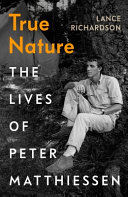
| Description | Discover the many lives of Peter Matthiessen - writer, naturalist, activist, CIA agent, Zen master - in this kaleidoscopic biography of an American literary giant. Author of The Snow Leopard, co-founder of the Paris Review and the only writer to have ever won the National Book Award for both fiction and nonfiction, Peter Matthiessen was a towering figure of twentieth-century American literary culture. He was also, briefly, an undercover agent for the fledgling CIA; an environmental activist; an advocate for Native American rights and California farmworkers; friends with the likes of Truman Capote and William Styron; and a daring explorer who visited every continent on Earth, scaling the Himalayas and floating through the Amazon on a balsawood raft. Across these many lives, Matthiessen was always searching for what he called his 'true nature' - an enlightened state of being, without ego - and this spiritual quest ultimately led him, even as he inflicted great pain on three wives and multiple children, to the highest ranks of Zen. Readers and critics have struggled to reconcile Matthiessen's extraordinarily varied achievements and literary output, which included everything from experimental novels to advocacy journalism. Now, for the first time, drawing on rich primary sources and hundreds of interviews, acclaimed biographer Lance Richardson pulls together the seemingly disparate threads of Matthiessen's story. With page-turning immediacy, Richardson illuminates how the writer's uncanny gifts enabled him to sense connections between ecological decline, racism and labour exploitation - to express, eloquently and presciently, that 'in a damaged human habitat, all problems merge'. 'Splendidly readable ... [Richardson] writes with flair and erudition' The Observer on House of Nutter 'Illuminating and vividly drawn' Sunday Telegraph on House of Nutter
===
The first biography of Peter Matthiessen, the novelist, naturalist, and Zen roshi, whose trailblazing work championed Native American rights and helped usher in the modern environmental movement, by award-winning writer Lance Richardson. “A stunning, formidable achievement by a brilliant biographer. Lance Richardson takes his readers on a wild ride with Peter Matthiessen.” —Kai Bird, Pulitzer Prize-winning co-author of American Prometheus “A fair-minded, grippingly paced, and tremendously readable narrative.” —Pico Iyer, Air Mail Peter Matthiessen (1927-2014), a towering figure of twentieth-century American letters, achieved so much during his lifetime, in so many different areas, that people have struggled to pin him down. While ambivalent about his WASP privilege—as a teenager he demanded that his name be removed from the New York Social Register—he attended Yale and cut his teeth in postwar Paris, co-founding The Paris Review as he worked undercover for the CIA. But then, after a rebellious stint as a Long Island fisherman, he escaped into a series of wild expeditions: floating through the Amazon to recover a prehistorical fossil; embedding with a tribe in Netherlands New Guinea; swimming with sharks off the coast of Australia. His novels, inspired by his travels, were unclassifiable meditations about Caymanian turtle hunters and frontier outlaws in the Florida Everglades. Meanwhile, his nonfiction became legendary: nature books like Wildlife in America—“key parts of the canon of emergent environmental writing,” says Bill McKibben—as well as advocacy journalism supporting Cesar Chavez, Leonard Peltier, and Native American land claims. Underlying all Matthiessen’s disparate pursuits was the same existential search—to find a cure for “deep restlessness.” This search was most profoundly articulated in The Snow Leopard, his famous account of a 250-mile wildlife survey across the Himalayas. In True Nature, Lance Richardson reconstructs the full scope of a spiritual quest that ultimately led Matthiessen, even as he inflicted great pain on his family, to the highest ranks of Zen. Drawing on rich primary sources and hundreds of interviews, Richardson depicts Matthiessen’s life with page-turning immediacy, while also illuminating how the writer’s uncanny gifts enabled him to sense connections between ecological decline, racism, and labor exploitation—to express, eloquently and presciently, that “in a damaged human habitat, all problems merge.” |
|---|